

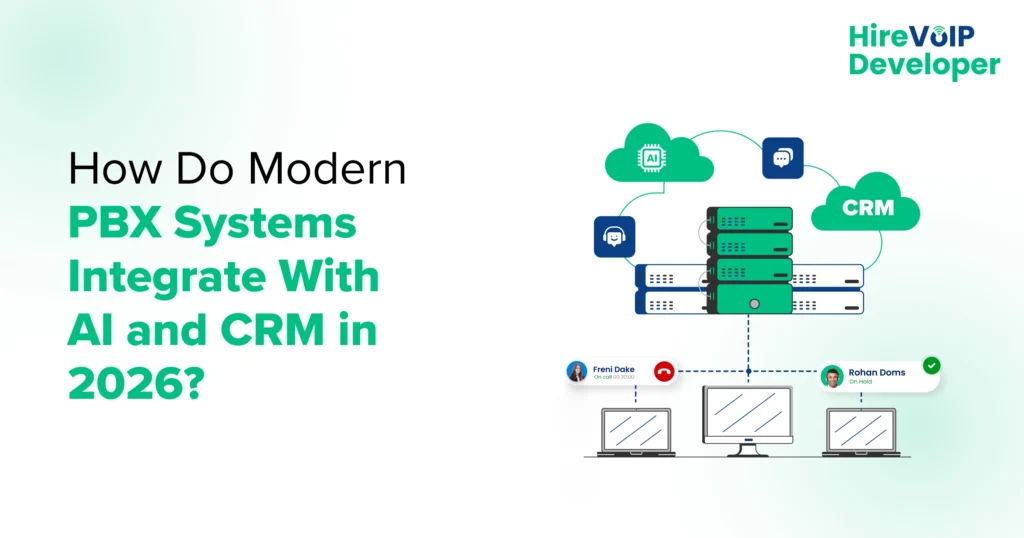
📝 Blog Summary
In 2026, PBX systems will evolve from voice routers into AI-powered communication hubs. This blog explores how integrating PBX with CRM platforms and AI assistants enables real-time context, more intelligent routing, and automated workflows.
“In the age of the customers, executives don’t decide how customer-centric their companies are — customers do.”
-Kate Leggett, Forrester Research
That single line defines the reality that modern communication leaders are facing today. In 2025-26, customer expectations evolve faster than most systems can adapt. If your communication systems don’t keep up with emerging PBX trends, your customers will move on to those who do.
What once was a simple phone exchange has become the foundation of intelligent engagement. Enterprises are embracing modern PBX frameworks and custom PBX solutions that align communication with customer intent rather than internal processes.
This is the essence of PBX modernization, evolving from legacy call routing to innovative, context-aware systems powered by CRM integration and AI assistants.
With GenAI for PBX systems turning voice data into actionable insight and PBX system upgrades enabling real-time responsiveness, the modern PBX is no longer about handling calls; it’s about understanding conversations.
So, how exactly is PBX changing in 2026? Let’s break down the most significant shifts.
What Are the Emerging PBX Modernization Trends in 2026?
Not long ago, a PBX system’s success was measured by uptime and clarity. Today, success looks different. The modern PBX is a living network, intelligent, integrated, and constantly learning.
As AI assistants and CRM systems become core to communication strategies, PBX modernization is transforming how teams connect with customers. Through PBX system upgrades, enterprises are moving beyond transactions to create conversations that think, learn, and evolve.
Let’s look at what’s shaping the new PBX landscape.
1. Deep CRM Integration for Context-Aware Communication
Modern PBX systems increasingly rely on integrating CRM with VoIP to transform every customer interaction into a data-driven opportunity. This shift ensures calls aren’t isolated events but part of a continuous, data-rich engagement loop.
Key highlights:
- Real-time Customer Visibility: Agents gain instant access to customer history, preferences, and past interactions.
- More Intelligent Routing: Calls can be automatically directed to the correct department or person based on CRM context.
- Actionable Insights: Every call becomes an opportunity to update CRM data and refine customer profiles.
Why it matters: Integrating a PBX with CRM equips businesses with a unified, end-to-end view of every customer interaction and touchpoint, which is essential for personalization and faster resolution.
2. Rise of AI and GenAI Assistants for Live Support and Call Summaries
AI assistants are moving beyond simple chatbot roles to become real-time decision-support systems within PBX frameworks.
In 2025, GenAI within PBX systems can:
- Live Call Intelligence: Listen to ongoing conversations and generate instant summaries for agent review.
- Proactive Guidance: Recommend next-best actions or relevant knowledge base articles during live interactions.
- Automated Data Sync: Automatically update CRMs or ticketing systems post-call, eliminating manual entry.
- Sentiment Detection: Identify the caller’s mood or intent to prioritize escalations and personalize responses.
Why it matters: This reduces manual effort, eliminates post-call backlog, and empowers agents to stay focused on what truly matters, meaningful conversations.
3. Cloud and Integration Frameworks Power Scalable Intelligence
The future of PBX lies in cloud-native architectures that combine scalability, flexibility, and continuous intelligence.
Modern integration frameworks enable:
- Seamless Module Expansion: Add analytics, AI, or new channels without re-engineering the entire PBX.
- Unified Communication Stacks: Combine voice, chat, and video into a single system.
- Real-Time Data Pipelines: Ensure AI models can process and act on live communication data.
Why it matters: A unified cloud-PBX architecture enables consolidated data exchange across AI, CRM, and communication layers, ensuring low latency, high reliability, and faster deployment cycles.
4. Omnichannel & Multimodal Integration
Customers today interact across multiple platforms, including calls, chat, social, and video. The modern PBX acts as the central nervous system connecting them all.
Emerging capabilities are as follows:
- Unified Customer Histories: Each channel contributes to a single shared record in the CRM.
- Channel Continuity: Conversations can move between media without losing context.
- Multimodal Support: Agents can access transcripts, call data, and chat logs from a single dashboard.
Why it matters: This creates an uninterrupted experience, no matter where the conversation starts or ends, boosting both agent productivity and customer satisfaction.
5. Security, Compliance & Fraud Prevention via AI
As PBX systems become data-heavy, AI-driven security frameworks ensure communication integrity and compliance.
AI capabilities now include:
- Voice Anomaly Detection: Identify spoofed calls or deepfake voices in real time.
- Compliance Monitoring: Auto-detect sensitive data to meet GDPR or HIPAA standards.
- Fraud Analytics: Spot unusual call patterns or data access attempts.
Why it matters: Security and compliance are no longer add-ons; they’re embedded directly into the PBX layer, ensuring privacy and trust at scale.
The convergence of CRM, AI assistants, and cloud frameworks marks a defining moment for enterprise communication. The next phase of PBX modernization isn’t just about better calls; it’s about building communication systems that understand the people behind them.
Now that we know where PBX is headed, let’s see how to make your system ready for what’s next.
Key market fact:
In 2024, the cloud PBX system market stood at USD 6.5 billion. It is forecast to grow at about 10.2% CAGR from 2026 through 2033, reaching around USD 15.2 billion by 2033
What are the Best Ways to Integrate AI into Hosted PBX?
Hosted PBX systems are rapidly shifting from static call management platforms to adaptive, AI-augmented communication engines. The goal isn’t to replace the human layer; it’s to build more intelligent systems that understand context, anticipate needs, and act autonomously. Implementing AI-driven automation into hosted PBX requires strategic integration across voice workflows, analytics engines, and CRM ecosystems.
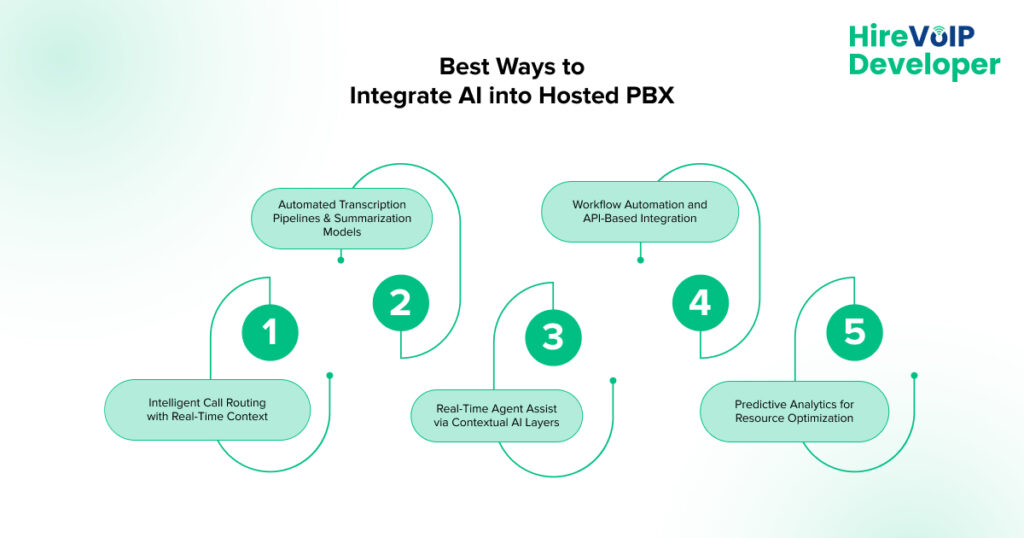
Below are five practical, technically grounded ways to add AI automation to hosted PBX systems.
1. Intelligent Call Routing with Real-Time Context
Traditional IVR trees depend on rigid logic. AI-driven routing, however, uses natural language processing (NLP) and sentiment detection to interpret caller intent in real time. By analyzing metadata, such as caller history, tone, and urgency, the PBX system dynamically assigns the call to the most qualified agent or department.
Modern enterprises implement this through purpose-built AI solutions for VoIP call centers, where intent recognition engines continuously learn from each interaction. Over time, the system refines routing accuracy and reduces both queue lengths and misdirected calls.
2. Automated Transcription Pipelines and Summarization Models
Speech-to-text engines are now embedded directly within hosted PBX infrastructures, allowing live call transcription, semantic tagging, and GenAI-powered summarization. Instead of just recording audio, these systems create structured, queryable data.
Transcripts are automatically linked to CRM entries, and summaries feed into customer profiles or ticketing systems for post-call actions. When integrated via WebRTC connectors or SIP APIs, this process operates in real time without interrupting voice streams, an essential feature for compliance-heavy industries.
3. Real-Time Agent Assist via Contextual AI Layers
Agent-assist modules act as overlays within the PBX dashboard, providing real-time cues during live conversations. AI listens to the conversation via mirrored data channels, then retrieves relevant scripts, FAQs, or troubleshooting guides.
Because these systems use retrieval-augmented generation (RAG) models, agents receive recommendations that are both context-aware and knowledge-base-validated, improving accuracy and reducing training time. The hybrid human–AI workflow ensures the PBX serves as an intelligent co-pilot rather than a replacement system.
4. Workflow Automation and API-Based Integration
Automation goes beyond calls; it’s about synchronized data synchronization across systems. AI can trigger post-call workflows, such as ticket creation, lead assignment, or CRM updates, via API event listeners and middleware orchestration.
Avoiding third-party app integration can create serious operational friction. Disconnected APIs lead to duplicate records, latency, and failed syncs. To prevent this, developers should implement middleware event queues (such as Kafka or RabbitMQ) that ensure every call event is captured and synced, regardless of the PBX vendor or CRM system.
5. Predictive Analytics for Resource Optimization
AI models trained on call traffic, duration, and resolution metrics can forecast peak volumes, allowing IT teams to scale resources preemptively.
Predictive analytics engines embedded in hosted PBX systems can dynamically allocate bandwidth, balance agent load, and even adjust codec selection based on network latency. This proactive model transforms infrastructure from reactive monitoring to self-healing communication ecosystems that anticipate disruptions before they impact customers.
With AI-driven orchestration, hosted PBX platforms mature into autonomous communication engines capable of real-time insight, proactive resource scaling, and cohesive workflow intelligence across the stack.
Now that the PBX is automated and intelligent, let’s look at how AI enhances performance for teams managing heavy call volumes.
How Can AI Improve Productivity for VoIP Solutions Handling Large Call Volumes?
High-volume VoIP environments don’t struggle with calls; they battle with context, coordination, and cognitive load. When hundreds or thousands of calls hit a hosted PBX daily, the bottlenecks aren’t lines or bandwidth anymore; they’re speed of understanding, quality of response, and the ability to orchestrate workflows across CRM, helpdesk, and analytics systems.
AI transforms the modern PBX from a routing system into a real-time decision engine. It listens, analyzes, predicts, surfaces data, and automates tasks, so teams can scale conversations without scaling headcount or complexity.
Here’s a clear breakdown of how AI shifts productivity for high-volume VoIP workloads:
How can Businesses Align CRM and AI Integrations with their Telecom Infrastructure?
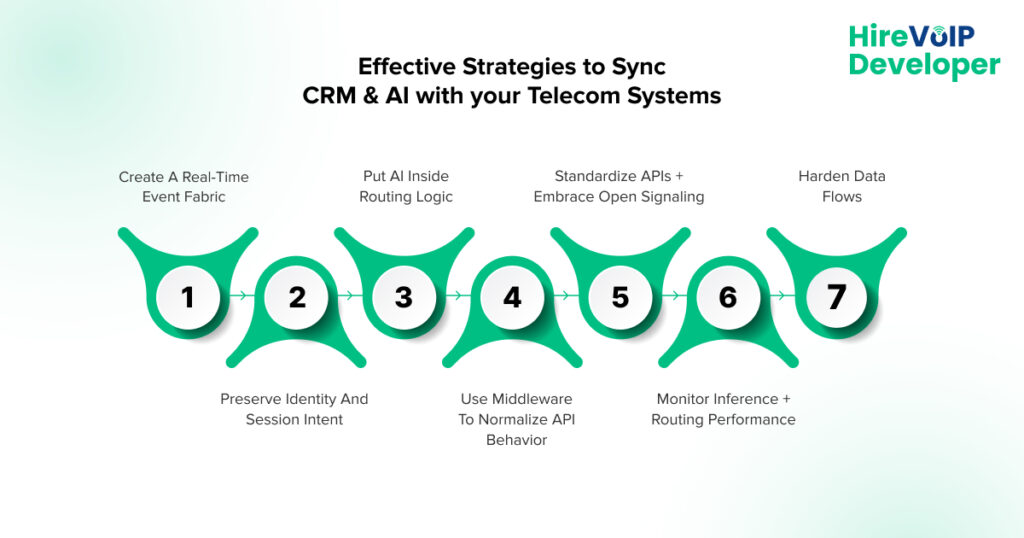
Aligning AI and CRM with your telecom stack is a core phase of PBX modernization, not an optional add-on. The mission: let voice, CRM, and AI share live session context so routing, agent support, logging, and post-call actions run off the same real-time data. This turns the modern PBX into a learning, context-aware communication fabric instead of a signaling switch.
To make this shift successful, let us break down the key architectural steps required to align AI, CRM, and PBX systems cohesively:
1. Create a Real-Time Event Fabric
Shift from polling to event-driven pipelines. Use SIP or WebRTC for media signaling and an event bus (Kafka, Webhooks, AMQP) for call metadata. Every call becomes a stateful object with shared identifiers across the PBX, AI engines, and CRM, so automation triggers fire instantly.
Many teams adopt proven VoIP integration best practices when building AI-enabled PBX stacks, especially around event streaming, API governance, and cross-system sync.
2. Preserve Identity and Session Intent
Identity tokens, historic ticket states, and CRM tags should persist from IVR to the agent desk. Pass sentiment, priority, and last-action cues to AI so it can surface context before the agent speaks.
3. Put AI Inside Routing Logic
Intent models and context scorers should sit in the call router loop, not after it. This ensures priority calls, escalations, or VIP profiles automatically route without human intervention, a core capability of GenAI-powered PBX systems.
4. Use Middleware to Normalize API Behavior
Different CRMs and PBX vendors speak different “languages.” Middleware standardizes requests, handles retries, and ensures idempotent delivery. This protects workflows during platform changes and scales neatly across multi-tenant environments.
5. Standardize APIs + Embrace Open Signaling
Adopt SIP/WebRTC for voice, REST/GraphQL for CRM data, and standard event schemas. This makes PBX system upgrades simpler and future-proof.
6. Monitor Inference + Routing Performance
Track transcription lag, CRM write times, AI inference latency, queue depth, and error rates. Observability ensures real-time automation doesn’t break under scale.
7. Harden Data Flows
Encrypt media (SRTP), token-gate CRM data, redact PII in AI transcripts, and enforce RBAC. Compliance and automation must evolve together.
When telecom, CRM, and AI systems operate on the same event fabric, your PBX becomes a cognitive system, routing smarter, supporting agents in real time, and syncing data automatically across platforms.
Let’s now explore how to unify PBX, CRM, and helpdesk workflows end-to-end.
What are the Steps to Build a Unified Communication Flow Between PBX, CRM, and Helpdesk Tools?
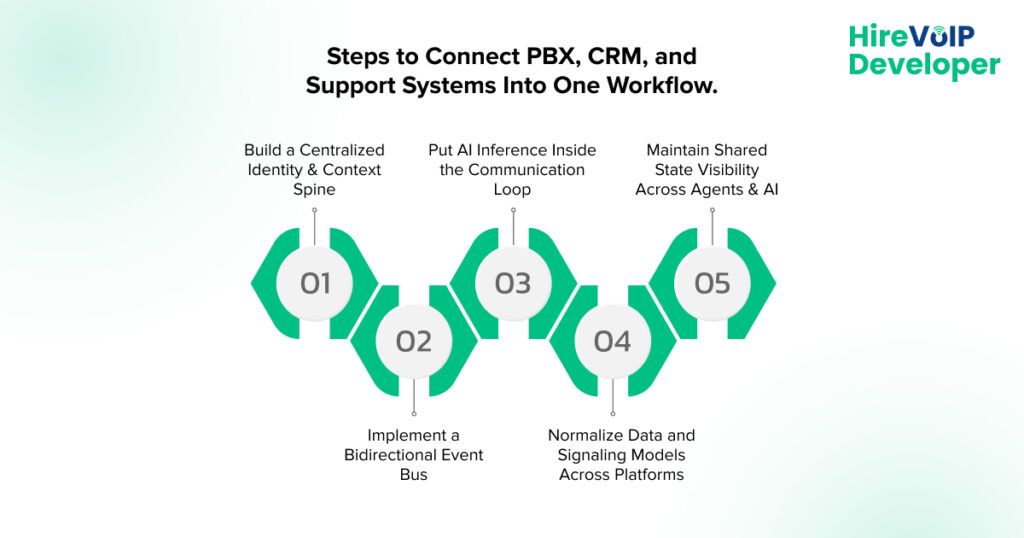
Building a unified communication fabric between PBX, CRM, and helpdesk platforms is one of the most critical pillars of modern PBX modernization. The objective isn’t just exchanging data; it’s enabling continuous context flow across every interaction so that voice events, customer intelligence, and automation operate as one synchronized system.
This foundation turns the PBX from a signaling hub into an AI-ready orchestration layer, where GenAI models enrich conversations with live context, and CRM systems execute workflows without manual intervention.
To build this unified stack, follow these core architectural practices:
1. Build a Centralized Identity and Context Spine
Every interaction needs a persistent identity token across systems, voice channels, CRM, ticketing, and agent consoles.
Use:
- Session IDs tied to SIP/WebRTC sessions
- CRM contact identifiers + account intelligence
- Unified customer context store
This allows the PBX to share real-time caller journey metadata, intent, sentiment, past tickets, and agent notes, ensuring AI engines and CRM workflows don’t operate unthinkingly.
2. Implement a Bidirectional Event Bus
Replace point-to-point integrations with an event-driven architecture.
Use:
- Webhooks, Kafka, or AMQP streams
- SIP event messages for call state changes
- REST/GraphQL for CRM automation triggers
This ensures an instant, bidirectional flow: the CRM enriches PBX routing, and the PBX feeds AI and ticketing systems with actionable insights.
3. Put AI Inference Inside the Communication Loop
AI shouldn’t operate after the call; it must operate during the call. Embed GenAI and ML services at the routing and session intelligence layer to:
- Detect intent and urgency
- Score customer priority
- Surface CRM records in real time
- Drive proactive workflows (pre-ticket, auto-recommendations, escalation triggers)
This moves you from reactive automation to predictive, behavior-driven call flow orchestration.
4. Normalize Data and Signaling Models Across Platforms
Different tools speak different languages.
Standardize around:
- SIP + WebRTC for media/signaling
- Universal customer schema across systems
- Normalized status codes and metadata structure
This avoids duplicate records, sync failures, and brittle workflows, a cornerstone of scalable PBX system upgrades and long-term automation.
5. Maintain Shared State Visibility Across Agents and AI
All systems should see the same live session state. Here’s what that alignment requires at an execution level:
- Queue state
- Routing decisions
- Agent actions
- Context tags & classifications
This lets AI assist agents mid-call and handle transitions such as transfers, escalations, or callbacks without losing context, a hallmark of enterprise-grade PBX modernization.
This architecture aligns directly with AI- and ML-integrated VoIP, where machine learning engines enrich call flows and automate context distribution across customer systems.
Conclusion
As PBX systems evolve from call-routing engines into intelligent, context-aware communication hubs, the advantage goes to teams that integrate AI, CRM, and automation early and do so thoughtfully.
The payoff is clear: faster resolution, proactive service, more intelligent routing, and infrastructure that strengthens with every interaction. Modernizing your PBX isn’t just an upgrade; it’s how communication becomes a strategic capability rather than a technical function.
If your PBX strategy is moving from “call handling” to “intelligent communication,” Hire VoIP Developer is the team you want building it. Contact us today!